
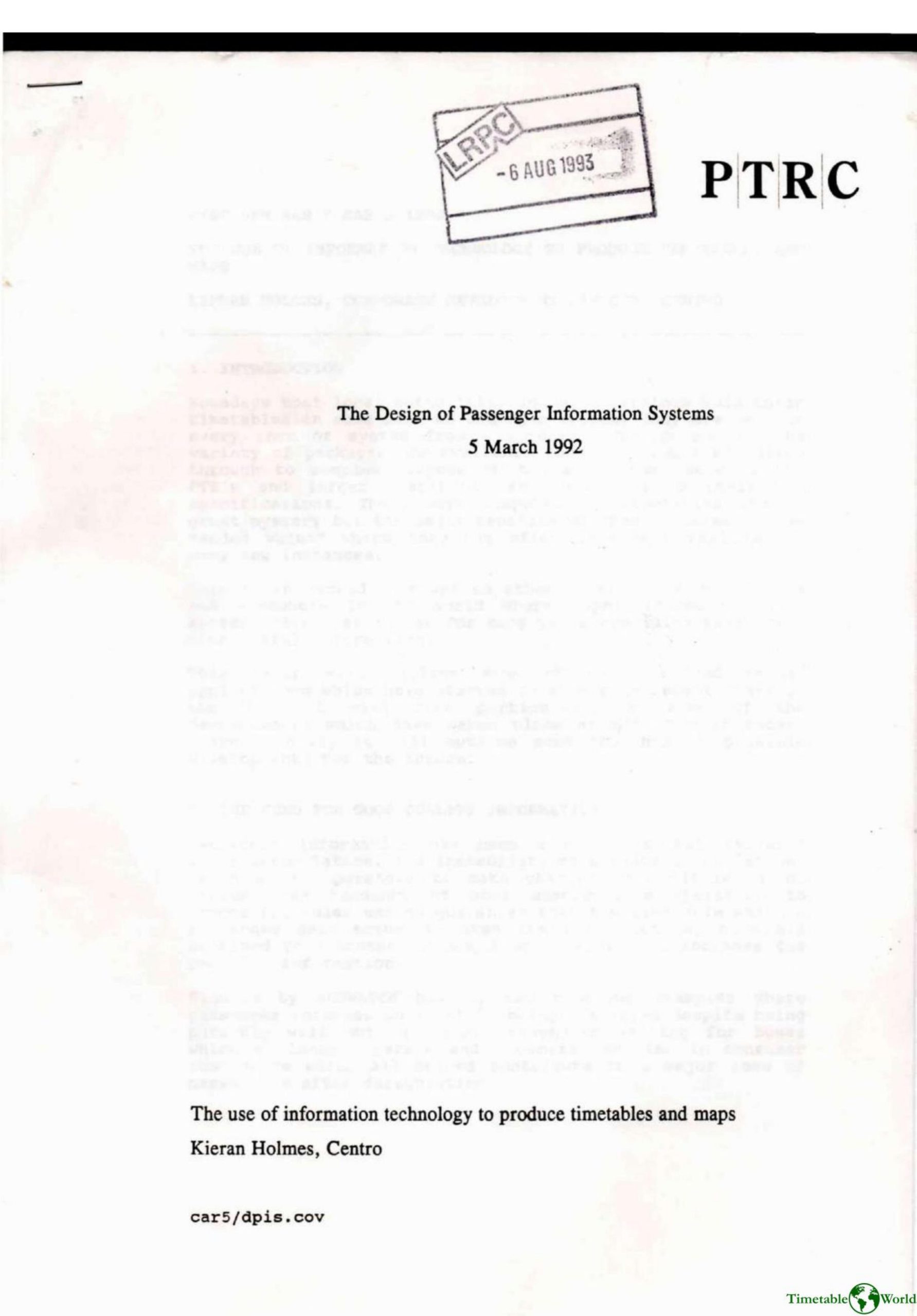
Holmes – THE DESIGN OF PASSENGER INFORMATION SYSTEMS 1992
£0.00
A downloadable PDF file for your personal use. Timetable World has applied OCR to make the text searchable, and each page carries a small Timetable World logo.
Description
Kieran Holmes outlines how information technology can transform passenger information by centralising timetables and network data. After deregulation, unreliable and out-of-date information increased passenger uncertainty, so computerised databases—like CENTRO’s West Midlands system containing timetables, routes, stops and digitised maps—offer a single, quickly updated source. Applications include on-demand single-sheet timetables at enquiry desks, stop-specific roadside publicity, printed artwork for mass leaflets, and computerised displays (bus station panels, videotext, PC-based personalised journey planners). GIS-style mapping supports route, network and interchange maps, vehicle-flow analyses for bus priority, infrastructure location and management reporting. Advanced services include Optimum Route systems that compute best A–B journeys and real-time information tied to vehicle tracking (Datatrak, GEC Tracker, pilot projects) that improve customer confidence, enable better choices and could integrate with traffic control for priority. The UK lags behind Europe, but CENTRO and Birmingham are developing integrated, real-time passenger information systems with EU DRIVE 2 support.
Additional information
| Pages | 14 |
|---|---|
| Filesize | 3.8Mb |
Related products
-
Anon – ONE-DIMENSIONAL TIMETABLES 1993
£0.00 Add to basket -

Association of Transport Co-ordinating Officers – PUBLIC TRANSPORT INFORMATION GOOD PRACTICE 2005
£0.00 Add to basket -
Association of Transport Co-ordinating Officers – PRINTED PUBLIC TRANSPORT INFORMATION 2001
£0.00 Add to basket -
Association of Train Operating Companies – PROVISION OF CUSTOMER INFORMATION 2016
£0.00 Add to basket