Căile Ferate Române
[Romanian Railways]
Background photo: 4-6-0 steam loco No. 230 062 on a passenger train c 1961. Image credit · Ray Reed. RCTS Photo Archive
Boundary Realignment and German Engineering Roots
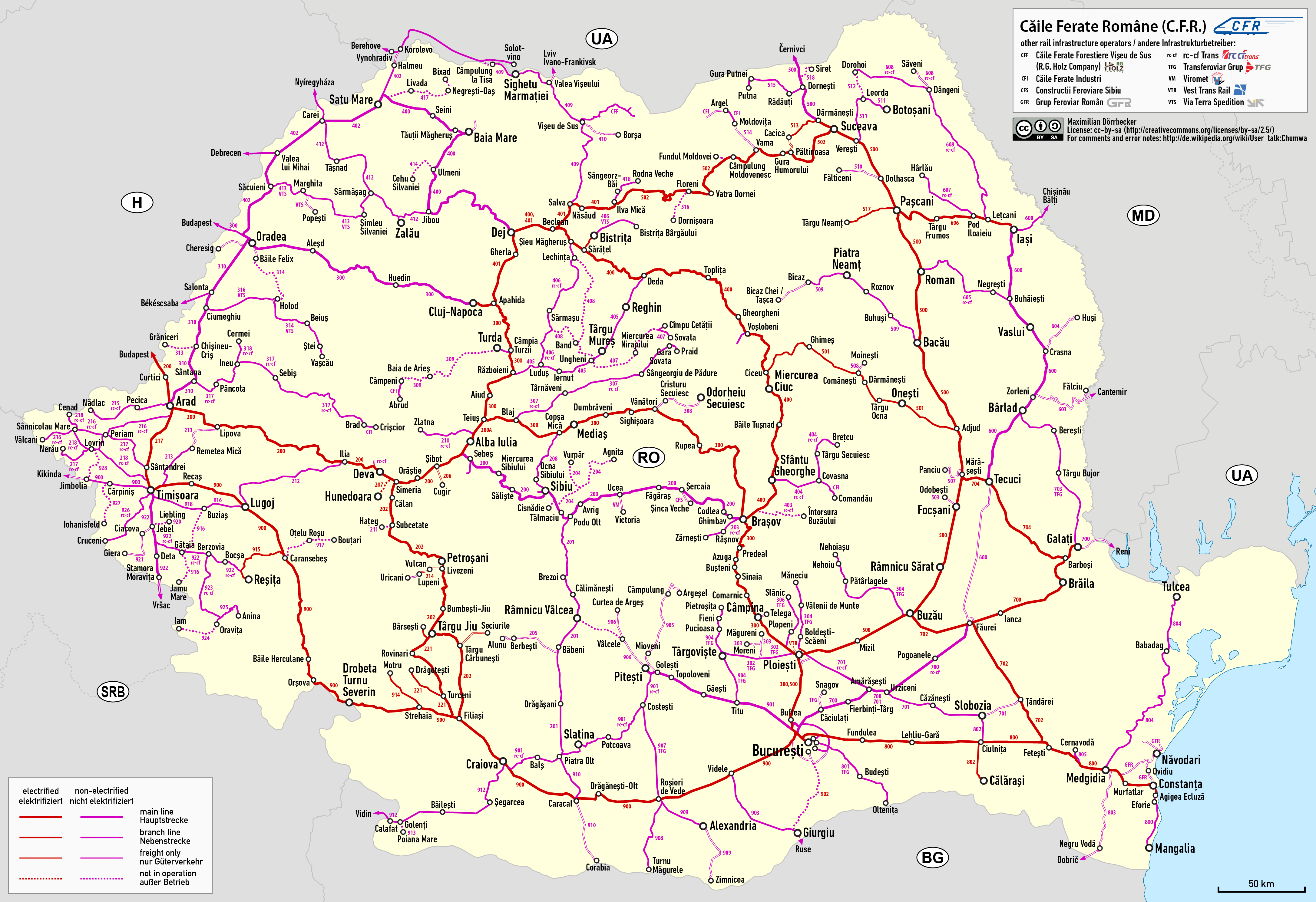
The development of Romania’s rail network was deeply influenced by the territorial restructuring of Southeastern Europe following the gradual retreat of the Ottoman Empire. Early lines in Wallachia and Moldavia—such as the Bucharest to Giurgiu route opened in 1869—were constructed to secure trade corridors toward the Danube and the Black Sea. Following the collapse of the Austro-Hungarian Empire after World War I, the unification of Transylvania, the Banat, and Bukovina into Greater Romania in 1918 incorporated extensive, pre-existing Austro-Hungarian rail infrastructure into the national operator, Căile Ferate Române (CFR). German technology played a foundational role in building and equipping these routes: Prussian and Austrian engineers designed much of the early track layout, while German industrial consortiums, such as the Strousberg consortium, supplied infrastructure. Later, domestic manufacturers like the Nicolae Malaxa works in Bucharest produced steam locomotives and diesel railcars based heavily on German designs, including Maybach-powered units.
Socialist Industrialisation and System Expansion
Under the post-World War II socialist regime, rail was prioritized as the primary engine for rapid industrial growth and heavy freight transport. Network capacity was dramatically expanded through widespread track doubling and an aggressive electrification program that began in the 1960s, utilizing a 25 kV 50 Hz AC overhead system. State-owned heavy industrial hubs, such as Electroputere in Craiova, manufactured high-powered electric locomotives under license from Swedish maker ASEA, alongside heavy diesel-hydraulic engines built by the 23 August (formerly Malaxa) Works. Public transit in major industrial centres was similarly structured around high-capacity tramways and trolleybus networks, providing essential commuter links for factory workforces.
Modern Challenges, Upgrades, and Corridor Realignment
Following the fall of communism in 1989 and CFR's restructuring into separate infrastructure and operating companies in 1998, the network suffered from decades of underinvestment and deferred maintenance. Today, Romania is undertaking significant modernization projects co-funded by the European Union to overhaul its core trunk lines. Priorities are focused on upgrading the Pan-European Corridor IV—connecting the Hungarian border at Curtici through Arad, Brașov, and Bucharest to the Black Sea port of Constanța—increasing operational speeds, upgrading signalling to ERTMS standards, and restoring key trans-Carpathian routes to boost regional and international transit capacity.
Timetables available to view and download
Click headings to open/close
1906-1945
| CFR 1906-04 [Romania] | 1906 | View online (free) | PDF Download [GBP4.00] |
| CFR 1914-04 [Romania] | 1914 | View online (free) | PDF Download [GBP4.00] |
| CFR 1926-05 [Romania] | 1926 | View online (free) | PDF Download [GBP4.00] |
| CFR 1929-09 [Romania] | 1929 | View online (free) | PDF Download [GBP4.00] |
| CFR 1934-06 [Romania] | 1934 | View online (free) | PDF Download [GBP4.00] |
| CFR 1935-08 [Romania] | 1935 | View online (free) | PDF Download [GBP4.00] |
| CFR 1938-10 [Romania] | 1938 | View online (free) | PDF Download [GBP4.00] |
| CFR 1939-05 [Romania] | 1939 | View online (free) | PDF Download [GBP4.00] |
| CFR 1941-05 [Romania] | 1941 | View online (free) | PDF Download [GBP4.00] |
| CFR 1943-05 [Romania] | 1943 | View online (free) | PDF Download [GBP4.00] |
1946-1989
1989-Present
Employee
| CFR Employee 1994-05 [Romania] | 1994 | View online (free) | PDF Download [GBP4.00] |