
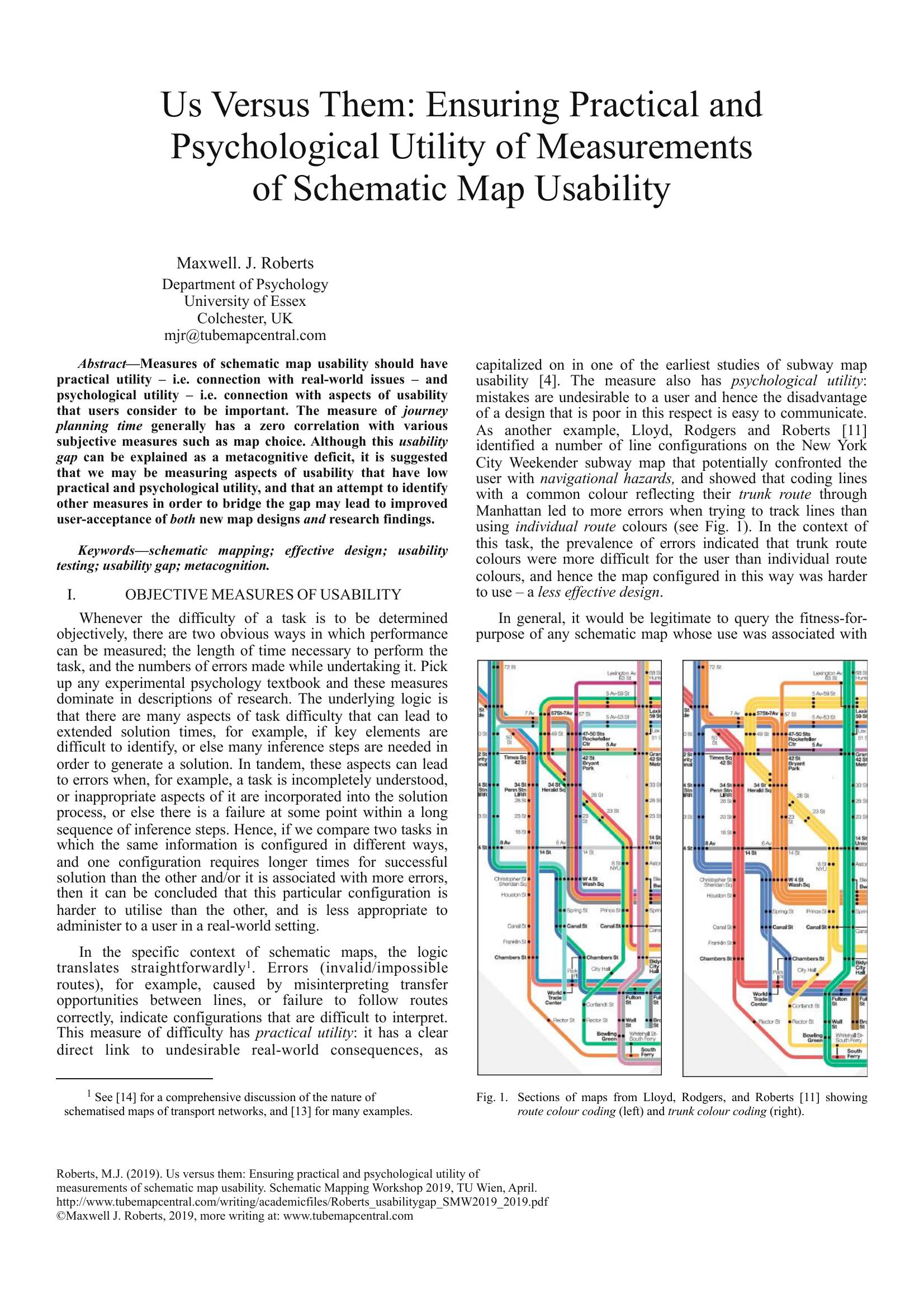
Roberts M – US VERSUS THEM 2019
£0.00
A downloadable PDF file for your personal use.
Description
Roberts argues that schematic map usability measures need both practical utility (real-world consequences) and psychological utility (users’ perceived importance). Traditional objective metrics—errors and proportions of inefficient journeys—clearly link to real outcomes and user concerns. However, journey planning time, often used when errors are rare, shows little correlation with subjective ratings: users frequently prefer maps that perform worse on timing metrics. Explanations include metacognitive limitations and entrenched design expectations (e.g., octolinear familiarity), but evidence suggests users simply do not value small planning-time differences. Some subjective judgments do align with objective problems (e.g., very poor commercial maps, concentric-circle designs), indicating users can detect certain deficiencies. Roberts recommends developing new measures that bridge the usability gap by having both practical and psychological relevance; he proposes “journey efficiency discriminability” as a candidate while noting challenges from topographical distortion. Better measures could improve acceptance of research findings and guide more effective, user-accepted map design.
Additional information
| Pages | 6 |
|---|---|
| Filesize | 0.6Mb |
Related products
-

Association of Train Operating Companies Information Development Group – GOOD PRACTICE GUIDES FOR CUSTOMER INFORMATION 2013
£0.00 Add to basket -

Association of Transport Co-ordinating Officers – PUBLIC TRANSPORT INFORMATION GOOD PRACTICE 2005
£0.00 Add to basket -
Annear – A TWIST ON THE MBTAS MAP DESIGN 2014
£0.00 Add to basket -
Association of Transport Co-ordinating Officers – PRINTED PUBLIC TRANSPORT INFORMATION 2003
£0.00 Add to basket