
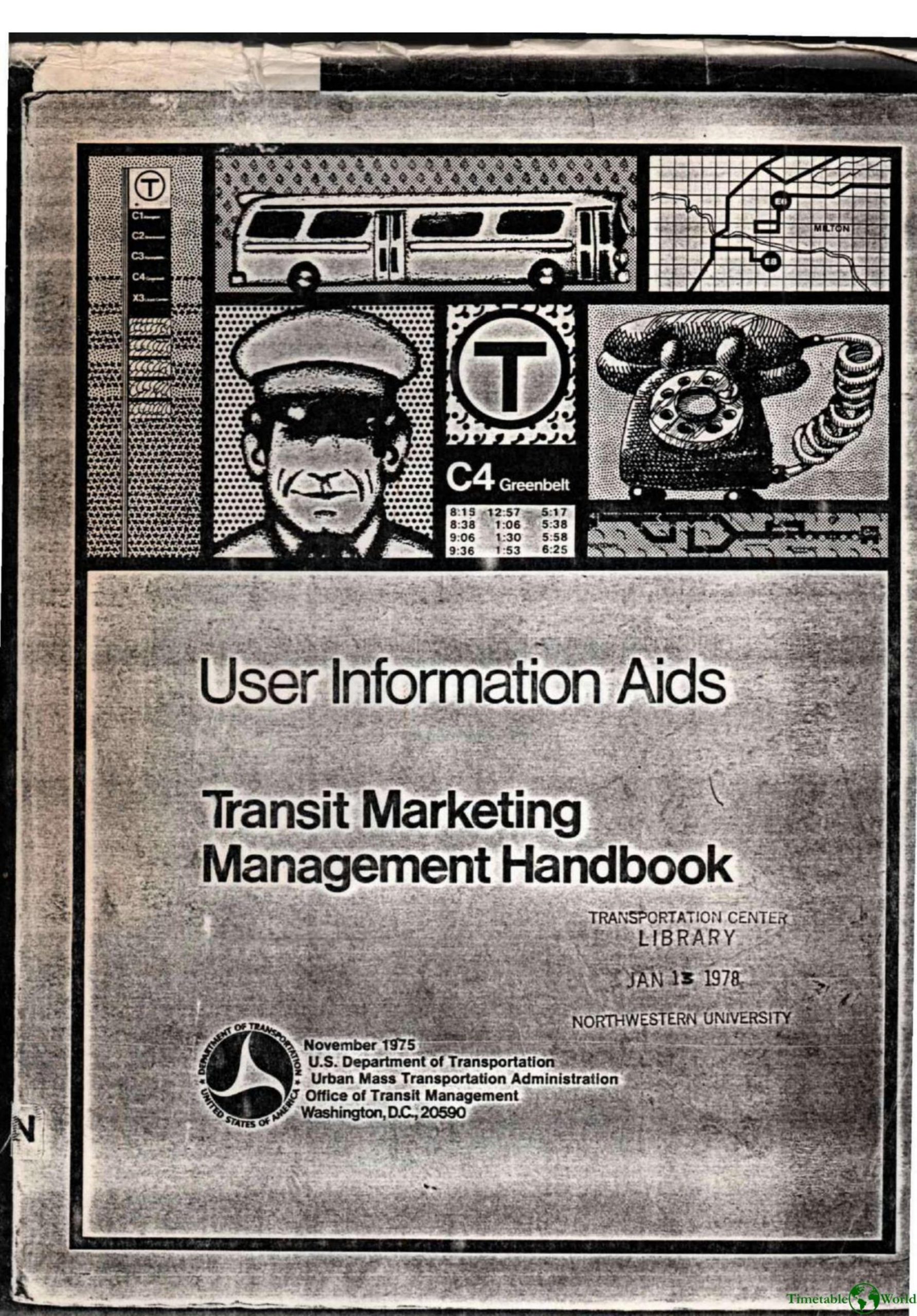
Urban Mass Transportation Administration (USA) – USER INFORMATION AIDS 1975
£0.00
A downloadable PDF file for your personal use. Timetable World has applied OCR to make the text searchable, and each page carries a small Timetable World logo.
Description
The Transit Marketing Management Handbook (1975) provides a practical, community-centered framework for designing comprehensive transit user-information systems. It prescribes a six-step process—develop community perspective, set objectives, apply systems thinking, create elements/modules, choose channels, and design the complete system with costs and schedules—while stressing user feedback and distinguishing general versus specific information. Four information types (geography, geometry, time, fare) must be repeatedly conveyed. Basic elements (names, numbers, colors, symbols) form modules (logos, route headings, maps, timetables) and components (schedules, signage, brochures, audio-visual aids, personnel). Map guidance differentiates schematic and non-schematic treatments. Distribution uses three channels—mass media, face-to-face, and public/private outlet networks—with supporting hardware (dispensers, racks). Planning tools include community profiles, inventories, forecasts, and cost-benefit analyses; priorities and phased schedules guide implementation and budgeting. Research favors pocket schedules, clear stop information and phone service. Key recommendations: pre-test materials, tailor design to target groups, maintain consistent identity, integrate staff as information ambassadors, and use continuous community feedback.
Additional information
| Pages | 172 |
|---|---|
| Filesize | 43.7Mb |
Related products
-

Association of Transport Co-ordinating Officers – PRINTED PUBLIC TRANSPORT INFORMATION 2001
£0.00 Add to basket -
Association of Train Operating Companies – PRESENTATION OF TIMETABLE INFORMATION 1997
£0.00 Add to basket -
Anon – ONE-DIMENSIONAL TIMETABLES 1993
£0.00 Add to basket -
Accent Marketing & Research – BUS STATION INFORMATION 1998
£0.00 Add to basket