
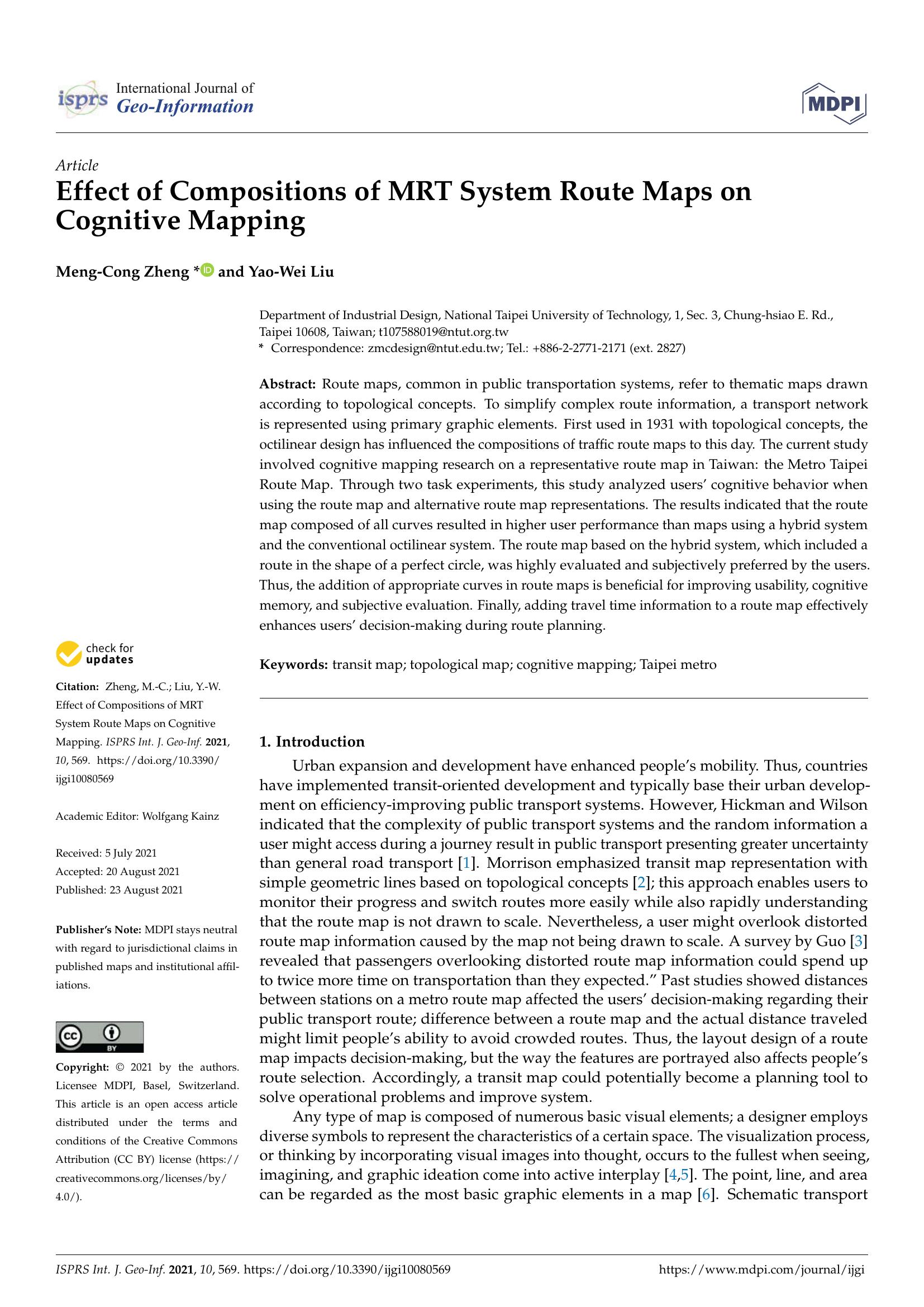
Zheng and Liu – EFFECT OF COMPOSITION OF M.R.T. SYSTEM ROUTE MAPS ON COGNITIVE MAPPING 2021
£0.00
A downloadable PDF file for your personal use.
Description
This study used Metro Taipei to assess how map geometry affects cognitive mapping and route planning. Experiment 1 (current map, 32 participants) found users draw routes before stations, rely on Taipei Main Station as a cognitive center, favor color and rounded forms, and prioritize minimizing travel time, transfers, and detours. Experiment 2 compared three redesigns—Proposal A (hybrid with a perfect Circular line), B (conventional octilinear), and C (all-curve)—with travel-time annotations. Objective measures showed Proposal C produced the fewest node and angle errors, Proposal A the smallest transfer error, and Proposal B the largest node errors; ANOVA indicated significant node-error differences (p < 0.05). Route choices were strongly shaped by graphical representation, with participants often avoiding perceived detours even at the cost of transfers. Subjectively, users preferred familiar octilinear styling but rated the hybrid A highest overall and supported adding travel-time labels. Recommendations: reduce excessive nodes and abrupt turns, emphasize visual centers, enlarge dense transfer areas, and introduce curve elements gradually alongside travel-time information to improve usability and memory.
Additional information
| Pages | 24 |
|---|---|
| Filesize | 1.3Mb |
Related products
-

American Public Transit Association – TIMETABLES 1982
£0.00 Add to basket -
Anon – ONE-DIMENSIONAL TIMETABLES 1993
£0.00 Add to basket -
Association of Transport Co-ordinating Officers – PRINTED PUBLIC TRANSPORT INFORMATION 2001
£0.00 Add to basket -
Association of Train Operating Companies – PROVISION OF CUSTOMER INFORMATION 2016
£0.00 Add to basket