
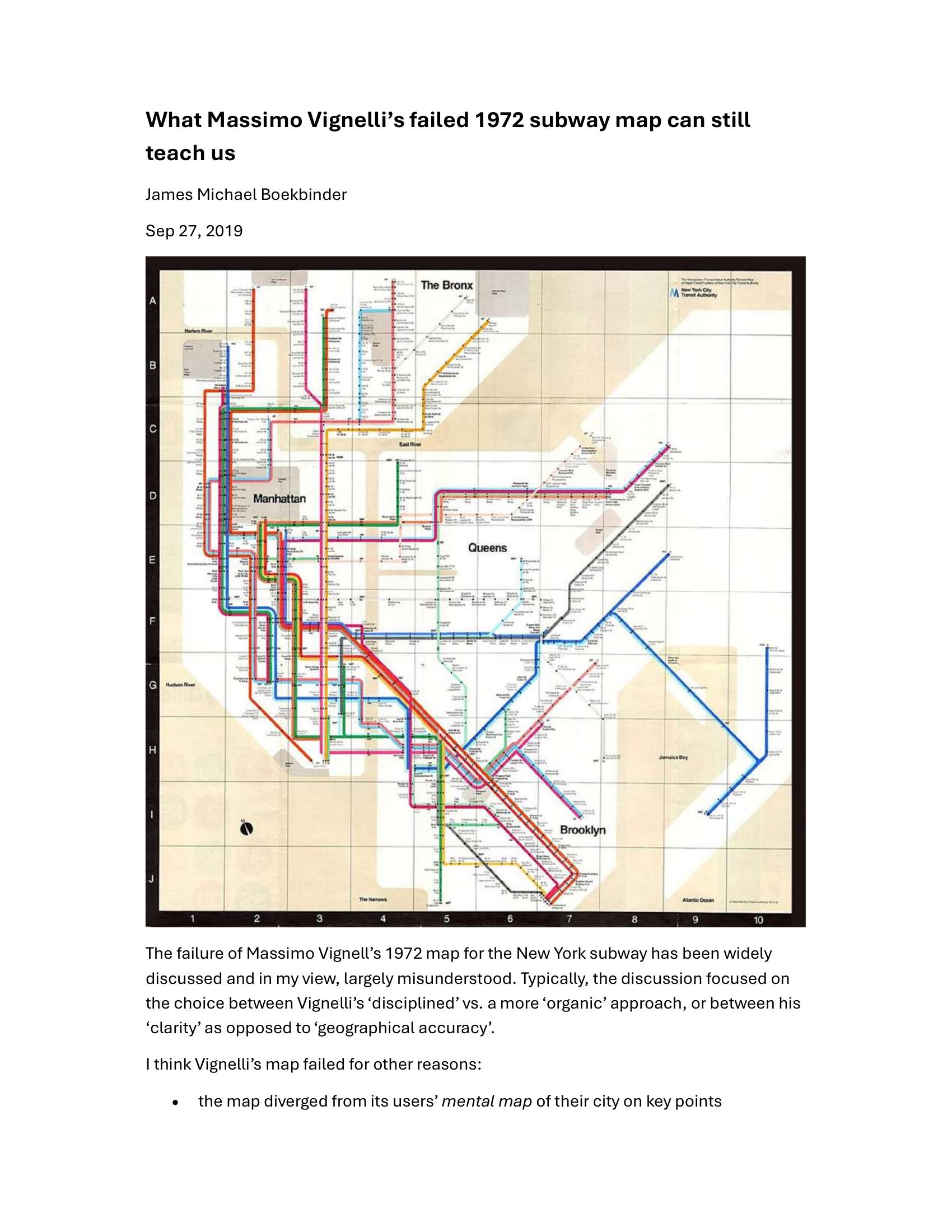
Boekbinder – WHAT MASSIMO VIGNELLIS FAILED 1972 SUBWAY MAP CAN STILL TEACH US 2019
£0.00
A downloadable PDF file for your personal use.
Description
The author argues Massimo Vignelli’s 1972 New York subway map failed not from a clash between ‘discipline’ and ‘organic’ styles but because it conflicted with users’ mental maps and used a counterproductive color scheme. With diagrammatic maps, matching residents’ cognitive model—key landmarks, grid orientation and spatial relationships—is essential; Vignelli’s distortion of Central Park, for example, misoriented surrounding stations. He also misread Henry Beck’s London solution: Beck removed truly redundant detail while preserving recognisable geographical cues, whereas Vignelli copied Beck’s visual styling without preserving the cognitive anchors that make a diagram usable. Vignelli’s muted, nonstandard colors blurred land/water contrast and harmed pre-attentive readability. The article stresses the need to test designs with real users, understand cognitive ergonomics, respect users’ lived experience, and only abandon conventions when clear benefits justify it. Practical takeaways: map designers must preserve users’ mental models, handle redundancy carefully, innovate cautiously, and prototype with users.
Additional information
| Pages | 5 |
|---|---|
| Filesize | 0.2Mb |
Related products
-

Association of Transport Co-ordinating Officers – PRINTED PUBLIC TRANSPORT INFORMATION 2003
£0.00 Add to basket -

Association of Train Operating Companies – HOW TO PRESENT TIMETABLE INFORMATION 2005
£0.00 Add to basket -
Anon – PICTURE THE TRANSIT SYSTEM EFFECTIVELY WITH A ROUTE MAP 1970
£0.00 Add to basket -

Attoma, Dubuc and Boyer-Moraes – MAPS BY ATTOMA 2014
£0.00 Add to basket