
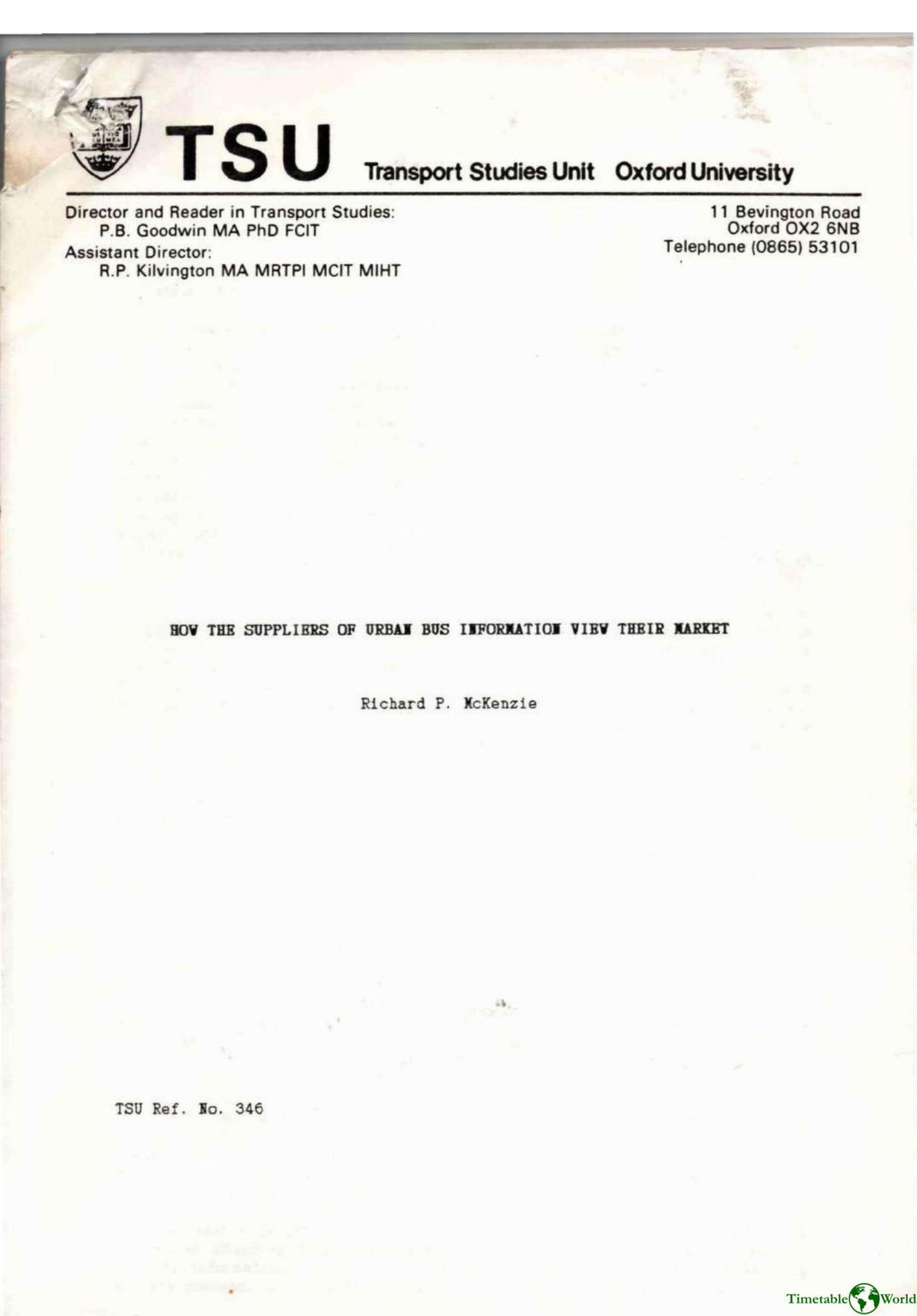
McKenzie – HOW THE SUPPLIERS OF URBAN BUS INFORMATION VIEW THEIR MARKET 1986
£0.00
A downloadable PDF file for your personal use. Timetable World has applied OCR to make the text searchable, and each page carries a small Timetable World logo.
Description
Interviewing 29 industry practitioners, the Transport Studies Unit found that passengers’ information needs vary widely: regular users require little detail while occasional visitors need much more. Needs depend on public transport familiarity, local geography, fare structure and service type. Timing and staged publicity matter for uptake, and comprehensibility is a major concern—timetables and maps are often misunderstood. Reassurance throughout the journey (stop displays, destination signs, verbal contact) is crucial. Service frequency and reliability strongly influence demand for timing information (a debated threshold around 10–20 minutes); even frequent routes need first/last and interchange info. Fare systems shape needs: conductors are valued, one-person operation limits contact, exact-fare systems deter unfamiliar users, and travelcards shift focus to timetables and reliability. The industry is moving from system-wide to local booklets; activity-oriented info targets tourists. In-bus information and real-time displays attract interest but opinions vary on practicality and cost-effectiveness. Accuracy is vital—wrong or missing information undermines confidence—so suppliers favor clear, localised, reassuring information with cautious real-time rollout.
Additional information
| Pages | 50 |
|---|---|
| Filesize | 13.7Mb |
Related products
-
Allard – THE DESIGN OF PUBLIC TRANSPORT MAPS 2009
£0.00 Add to basket -
Anon – ONE-DIMENSIONAL TIMETABLES 1993
£0.00 Add to basket -
Anon – PICTURE THE TRANSIT SYSTEM EFFECTIVELY WITH A ROUTE MAP 1970
£0.00 Add to basket -
Association of Public Transport Co-ordination Officers – PUBLIC TRANSPORT INFORMATION 1982
£0.00 Add to basket