
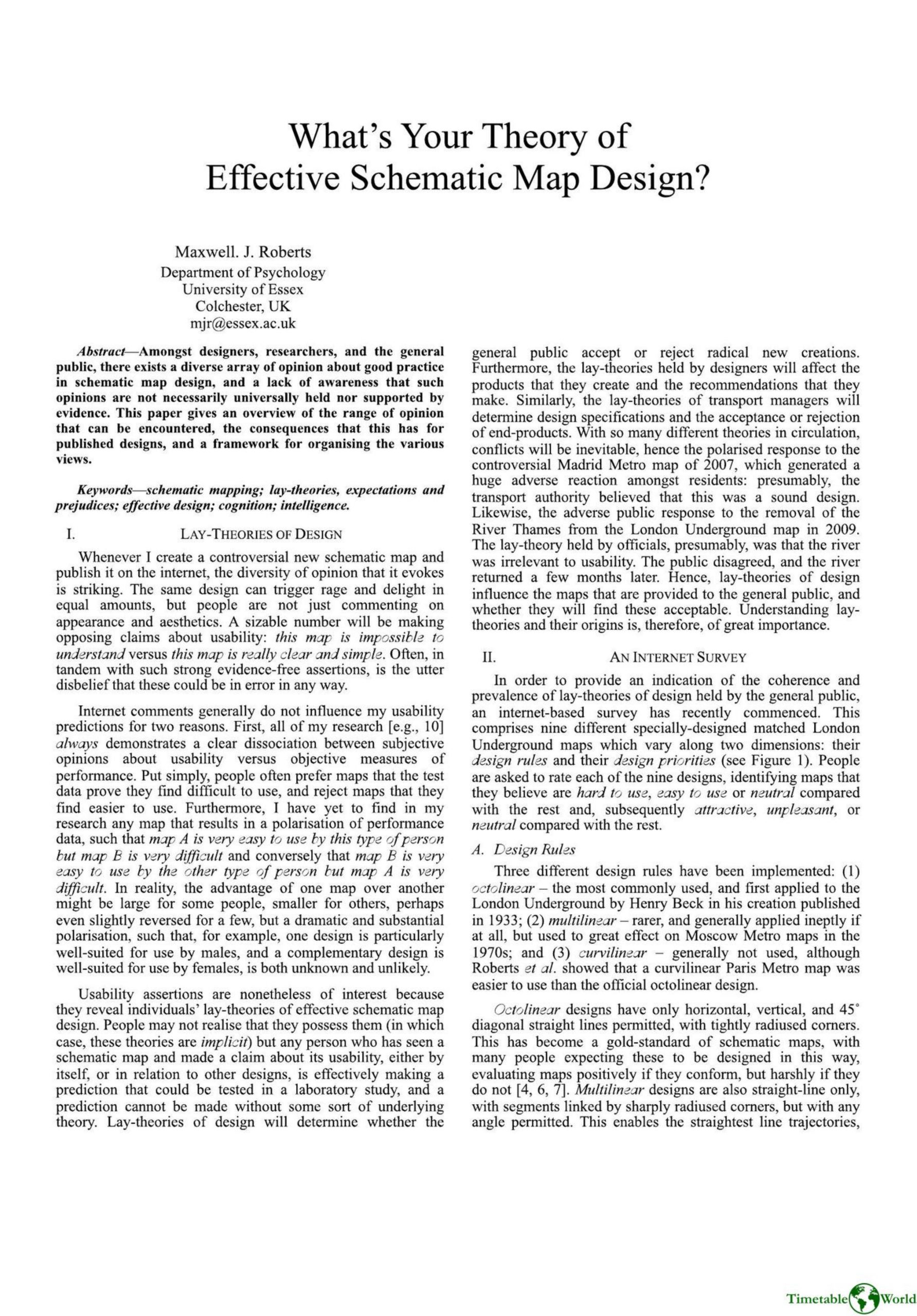
Roberts M – WHATS YOUR THEORY OF EFFECTIVE SCHEMATIC MAP DESIGN 2014
£0.00
A downloadable PDF file for your personal use. Timetable World has applied OCR to make the text searchable, and each page carries a small Timetable World logo.
Description
Roberts examines conflicting “lay‑theories” about schematic transit-map design held by the public, designers and officials, showing these beliefs shape acceptance of new maps. He reports an internet survey using nine London Underground schematics that vary by design rule (octolinear, multilinear, curvilinear) and priority (geographical, compact, stylised). Preliminary results from 100 respondents show a British bias for linear/octolinear designs, sensitivity to simple line trajectories, and a dissociation between perceived usability (engagement) and objective usability. Roberts synthesises design criteria from literature and proposes a five‑part framework—simplicity, coherence, harmony, balance and topographicity—grounded in psychological concepts (cognitive load, capacity, expertise, attention capture). He argues Beck’s classic map succeeded not merely through straight lines but by minimising corners and cognitive load. The framework is neutral about specific angle rules and requires empirical fleshing‑out: different networks may demand different tradeoffs, and objective testing is needed to prioritise criteria for effective, widely accepted schematic maps.
Additional information
| Pages | 9 |
|---|---|
| Filesize | 4.6Mb |
Related products
-
Association of Train Operating Companies – PRESENTATION OF TIMETABLE INFORMATION 1997
£0.00 Add to basket -
Association of Train Operating Companies – PASSENGER INFORMATION DURING DISRUPTION 2014
£0.00 Add to basket -
Association of Train Operating Companies – PROVISION OF CUSTOMER INFORMATION 2016
£0.00 Add to basket -
Association of Transport Co-ordinating Officers – PRINTED INFORMATION AT BUS STOPS 2004
£0.00 Add to basket