
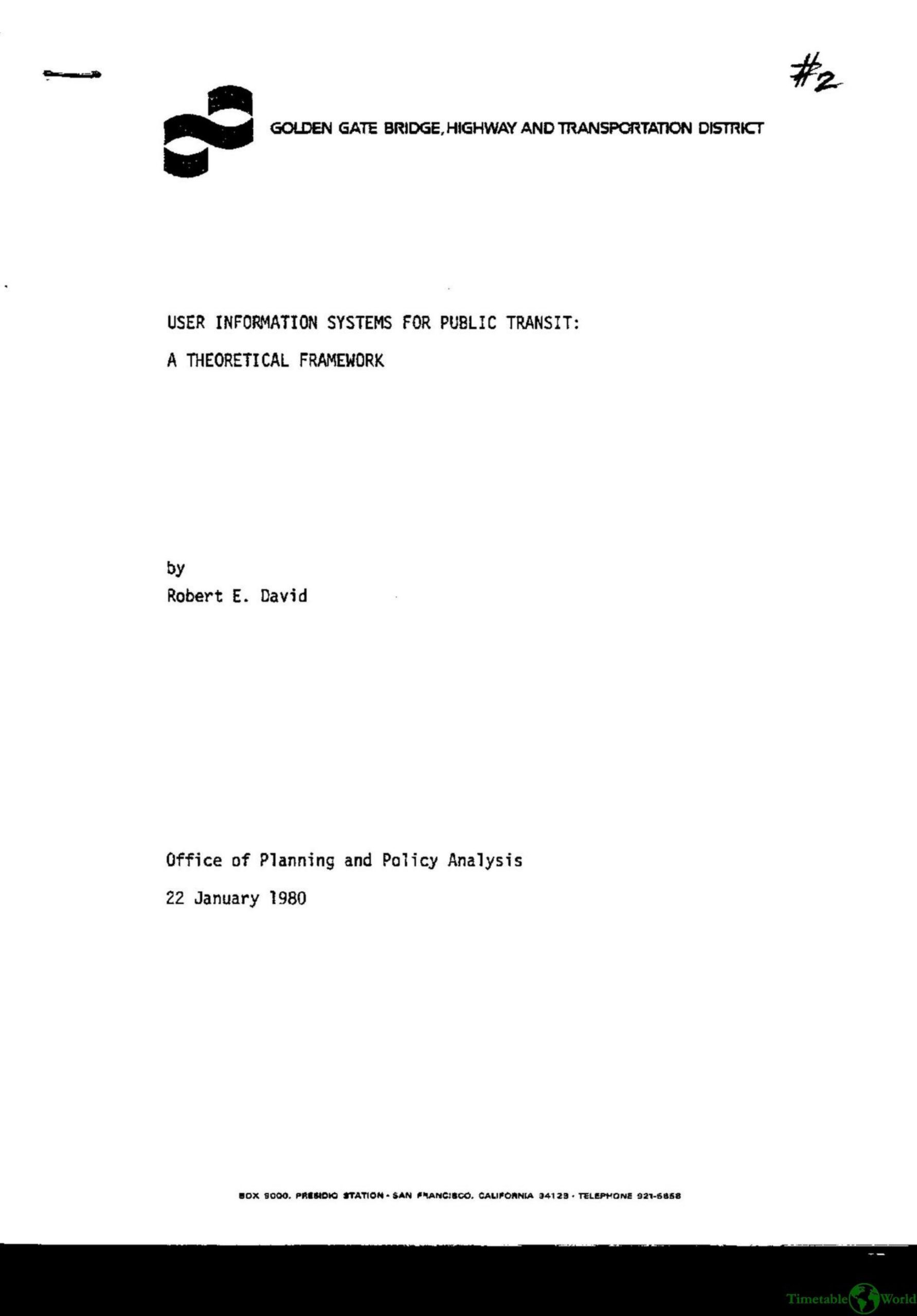
David – USER INFORMATION SYSTEMS FOR PUBLIC TRANSIT 1980
£0.00
A downloadable PDF file for your personal use. Timetable World has applied OCR to make the text searchable, and each page carries a small Timetable World logo.
Description
This 1980 paper by Robert E. David proposes a theoretical framework for public transit user information systems built from two complementary morphologies: one generating the range of user information problems and the other generating possible information solutions. It models users and transit systems as temporal continuums and adds sub-morphologies for user, system, and environmental characteristics to produce comprehensive problem sets. Solutions are framed using Shannon’s communication model (source, transmitter, channel, receiver, noise) and include overt devices (signs, maps, phone centers) and covert environmental cues (architecture, vehicle design). The author introduces “message attitude” (active marketing, passive supply, covert signals) and language modes, and emphasizes the need to reduce the infinite variety of problems and solutions through market segmentation and evaluation. He outlines performance variables (production cost, distribution, message clarity, demand, user confidence) and evaluation methods (field observation, lab tests, surveys, document monitoring). The paper highlights limited prior research and calls for rigorous testing of alternative information designs and context–solution correlations.
Additional information
| Pages | 34 |
|---|---|
| Filesize | 6.6Mb |
Related products
-
Association of Transport Co-ordinating Officers – PRINTED PUBLIC TRANSPORT INFORMATION 2001
£0.00 Add to basket -
Association of Train Operating Companies – PASSENGER INFORMATION DURING DISRUPTION 2014
£0.00 Add to basket -
Anceresi, Gatti, Vecchi, Marelli and Rinaldi – A MAP OF WORDS 2023
£0.00 Add to basket -
Anon – ONE-DIMENSIONAL TIMETABLES 1993
£0.00 Add to basket