
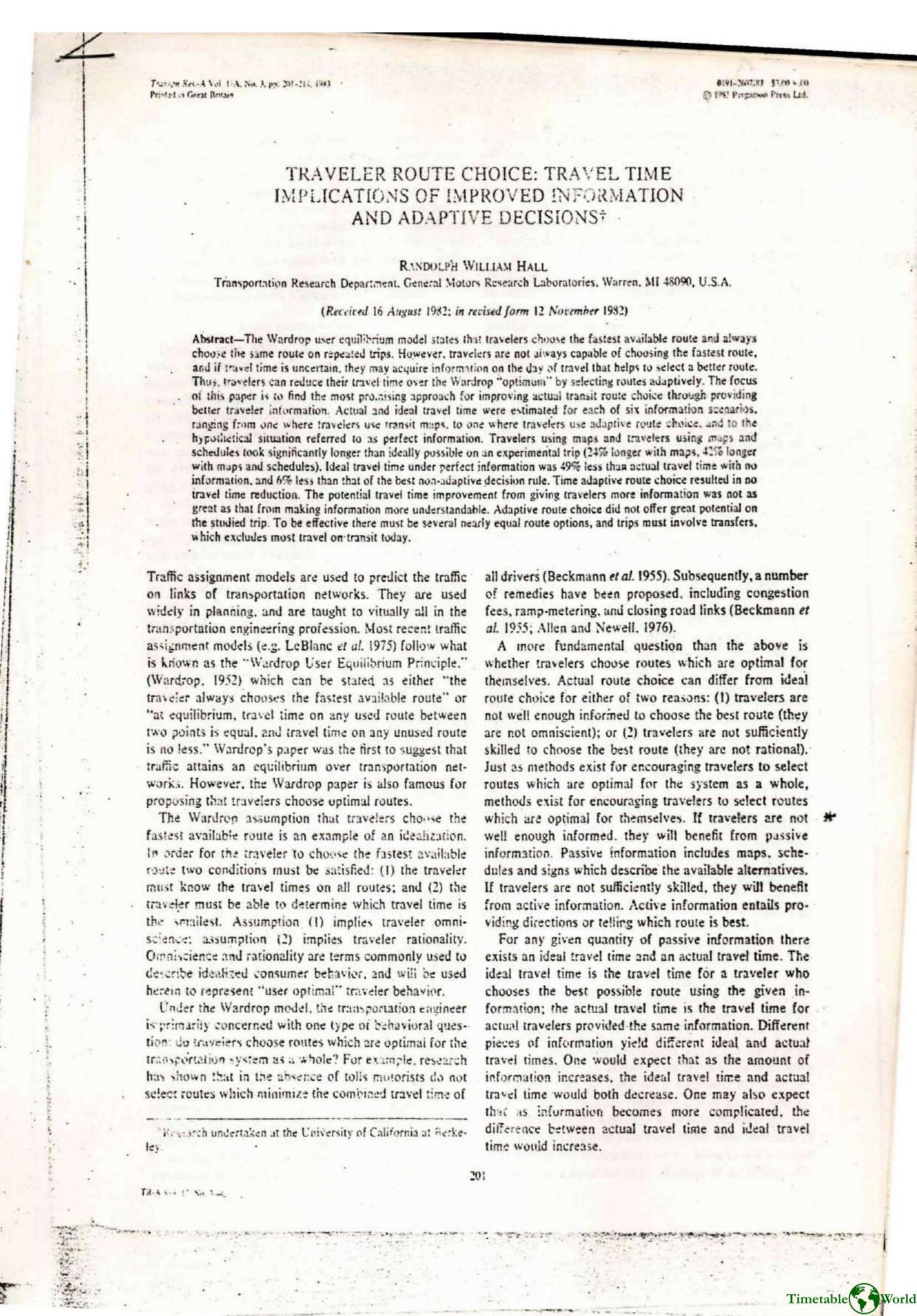
Hall – TRAVELER ROUTE CHOICE 1983
£0.00
A downloadable PDF file for your personal use. Timetable World has applied OCR to make the text searchable, and each page carries a small Timetable World logo.
Description
This paper critiques the Wardrop user-equilibrium assumption that travelers always choose the fastest fixed route, showing real travelers lack omniscience and perfect rationality. Hall evaluates five information scenarios (maps; maps+schedules; known travel-time distributions; in‑route adaptive choice; perfect information) using observed trips by unfamiliar students in Berkeley. Maps substantially reduced travel time versus no information, but schedules were seldom used and provided little actual benefit despite larger theoretical gains. Calculations show perfect information could cut travel time roughly 49% versus no-information, but yields only about a 6% improvement over the best fixed-route choice in this case. Time-adaptive route choice produced no travel-time gain here. The study concludes that making information more understandable is often more valuable than simply increasing quantity, and that adaptive strategies help only when multiple nearly equal route options and transfers exist—conditions uncommon in typical transit use. The paper proposes methods to quantify information’s travel-time benefits and warns Wardrop’s model can misrepresent individual behavior.
Additional information
| Pages | 14 |
|---|---|
| Filesize | 4.9Mb |
Related products
-
Anceresi, Gatti, Vecchi, Marelli and Rinaldi – A MAP OF WORDS 2023
£0.00 Add to basket -
Allard – THE DESIGN OF PUBLIC TRANSPORT MAPS 2009
£0.00 Add to basket -
Association of Public Transport Co-ordination Officers – PUBLIC TRANSPORT INFORMATION 1982
£0.00 Add to basket -
Anon – ONE-DIMENSIONAL TIMETABLES 1993
£0.00 Add to basket