
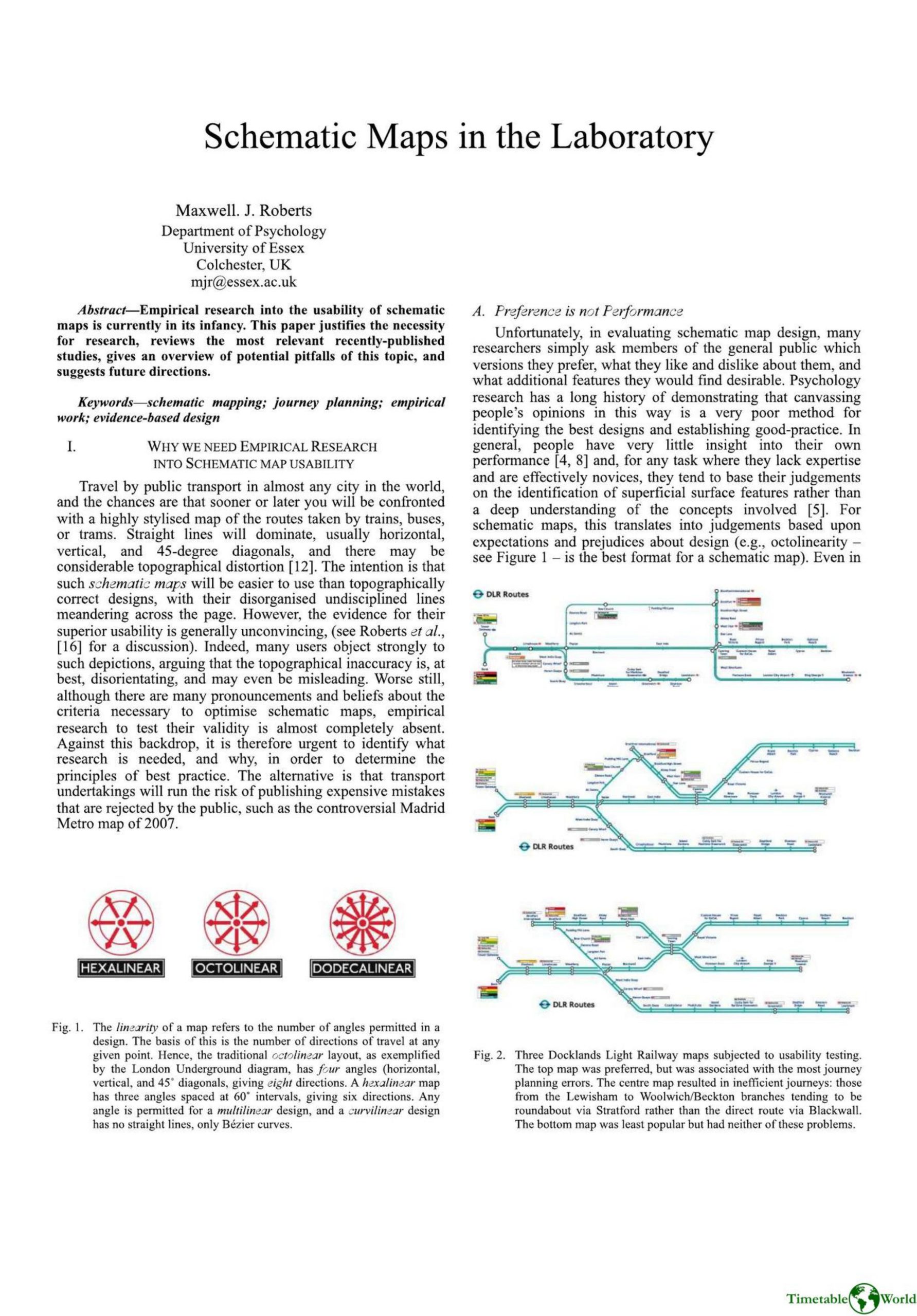
Roberts M – SCHEMATIC MAPS IN THE LABORATORY 2014
£0.00
A downloadable PDF file for your personal use. Timetable World has applied OCR to make the text searchable, and each page carries a small Timetable World logo.
Description
Roberts argues that empirical research into schematic public-transport maps is urgently needed because common design beliefs lack evidence. Schematic maps (e.g., octolinear) are assumed easier to use, yet user preferences often contradict objective performance: people may prefer maps that produce more errors, while efficient designs (including novel curvilinear layouts) can be rejected for unfamiliarity. Existing design guidelines—octolinearity, straightened trajectories, preserving relative positions, equalized inter-station spacing, and tidy label placement—are widely asserted but largely unevidenced and sometimes conflict, forcing trade-offs. Roberts outlines experimental strategies: station-finding and journey-planning tasks measured by time, errors, gaze tracking, and recall; between- and within-subject designs; and controlling for individual differences (expertise, spatial ability, age, cultural bias). Early studies show curvilinear designs can speed planning, while perceptual analyses (e.g., mongrels) may predict engagement more than usability. The paper calls for systematic, evidence-based testing across networks and user groups to develop robust, generalizable design principles.
Additional information
| Pages | 6 |
|---|---|
| Filesize | 3.4Mb |
Related products
-
Association of Transport Co-ordinating Officers – PRINTED PUBLIC TRANSPORT INFORMATION 2001
£0.00 Add to basket -
Attoma – MAPPING MOBILITY 2024
£0.00 Add to basket -
Accent Marketing & Research – MAPS AND TIMETABLES AT BUS STOPS 1999
£0.00 Add to basket -
Association of Train Operating Companies – PRESENTATION OF TIMETABLE INFORMATION 1997
£0.00 Add to basket