
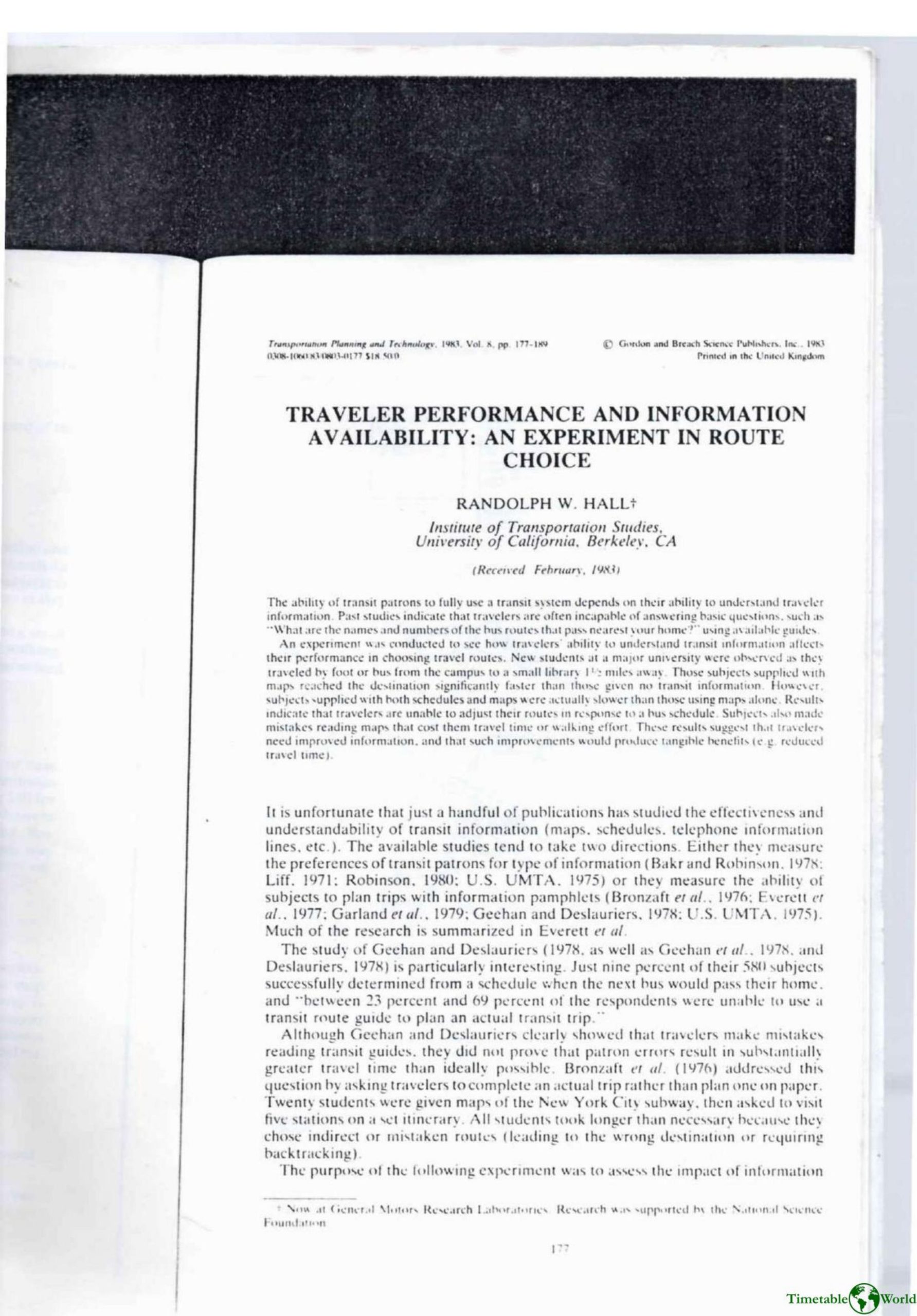
Hall – TRAVELER PERFORMANCE AND INFORMATION AVAILABILITY 1983
£0.00
A downloadable PDF file for your personal use. Timetable World has applied OCR to make the text searchable, and each page carries a small Timetable World logo.
Description
Hall conducted a field experiment with 50 new university students to assess how transit information affects route choice to a library 1.5 miles from campus. Subjects were assigned to three groups: no information (20), maps only (15), and maps plus schedules (15), and observed from departure to return. Map users reached the destination significantly faster than those with no information (about 7.2 minutes faster to the library; 10.5 minutes faster total). However, adding schedules yielded no benefit—most subjects ignored them and could not use schedules to adjust routes. Travelers made frequent errors reading maps, failed to find the closest stops, and were confused by irregular routings and map colorings. Route choice proved dynamic and driven by preferences, personality, and skill more than optimal travel time. Subjects heavily relied on bus stop signs, transit employees, and strangers for directions. Hall concludes passive information (maps, schedules) is often insufficient; clearer, improved information or active guidance would likely yield tangible travel-time benefits.
Additional information
| Pages | 13 |
|---|---|
| Filesize | 3.6Mb |
Related products
-
Association of Transport Co-ordinating Officers – PRINTED PUBLIC TRANSPORT INFORMATION 2001
£0.00 Add to basket -
American Public Transit Association – TRANSIT MAPS 1984
£0.00 Add to basket -
Attoma, Dubuc and Boyer-Moraes – MAPS BY ATTOMA 2014
£0.00 Add to basket -
Attoma – MAPPING MOBILITY 2024
£0.00 Add to basket