
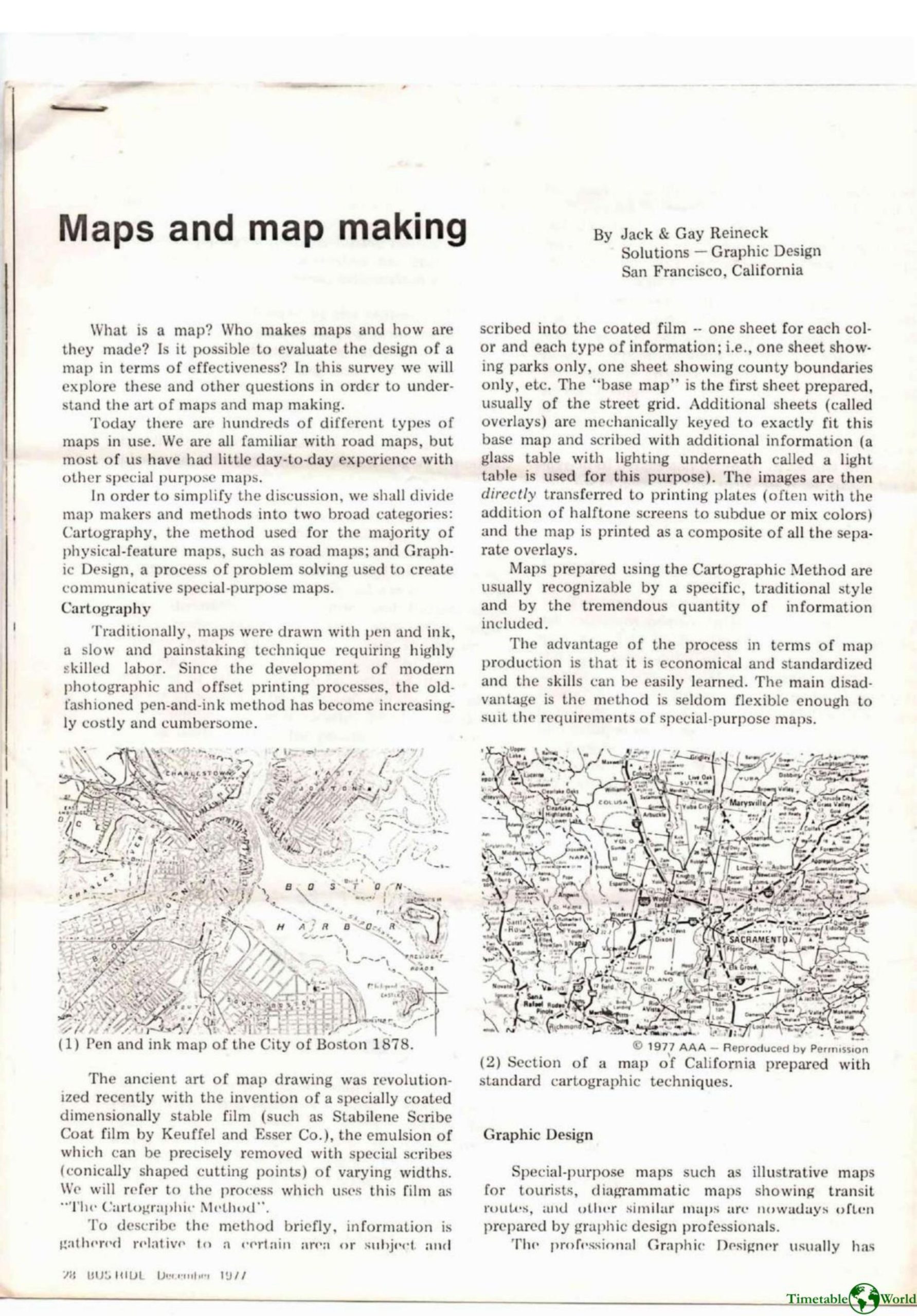
Reineck – MAPS AND MAP MAKING 1977
£0.00
A downloadable PDF file for your personal use. Timetable World has applied OCR to make the text searchable, and each page carries a small Timetable World logo.
Description
The essay distinguishes two mapmaking approaches: Cartography and Graphic Design. Cartography, historically pen-and-ink, evolved with coated scribe films and overlay techniques—creating standardized, information-dense base maps that are economical and reproducible but often inflexible for special-purpose needs. Graphic Design treats mapmaking as a communication problem: professionally trained designers create special-purpose maps (tourist, transit, diagrammatic, pictorial) through sketching, client collaboration, and iterative “designed roughs,” choosing styles, information hierarchy, colors, and production methods to maximize clarity and usability. Designers must consider size, budget, printing, legibility, and what to include or omit. Map effectiveness should be evaluated by use: whether style fits function, symbols and typefaces are clear to experts and laypeople, color balance, legend clarity, and prominence of important information. The essay illustrates these principles with examples of visitors’ maps, bus and transit diagrams, and panoramic/tourist maps, showing how graphic design better serves special-purpose mapping while cartography remains suited to comprehensive physical-feature maps.
Additional information
| Pages | 3 |
|---|---|
| Filesize | 1.2Mb |
Related products
-
Association of Transport Co-ordinating Officers – PUBLIC TRANSPORT INFORMATION GOOD PRACTICE 2005
£0.00 Add to basket -
Allard – THE DESIGN OF PUBLIC TRANSPORT MAPS 2009
£0.00 Add to basket -

Association of Train Operating Companies Information Development Group – GOOD PRACTICE GUIDES FOR CUSTOMER INFORMATION 2013
£0.00 Add to basket -

American Public Transit Association – TIMETABLES 1982
£0.00 Add to basket