
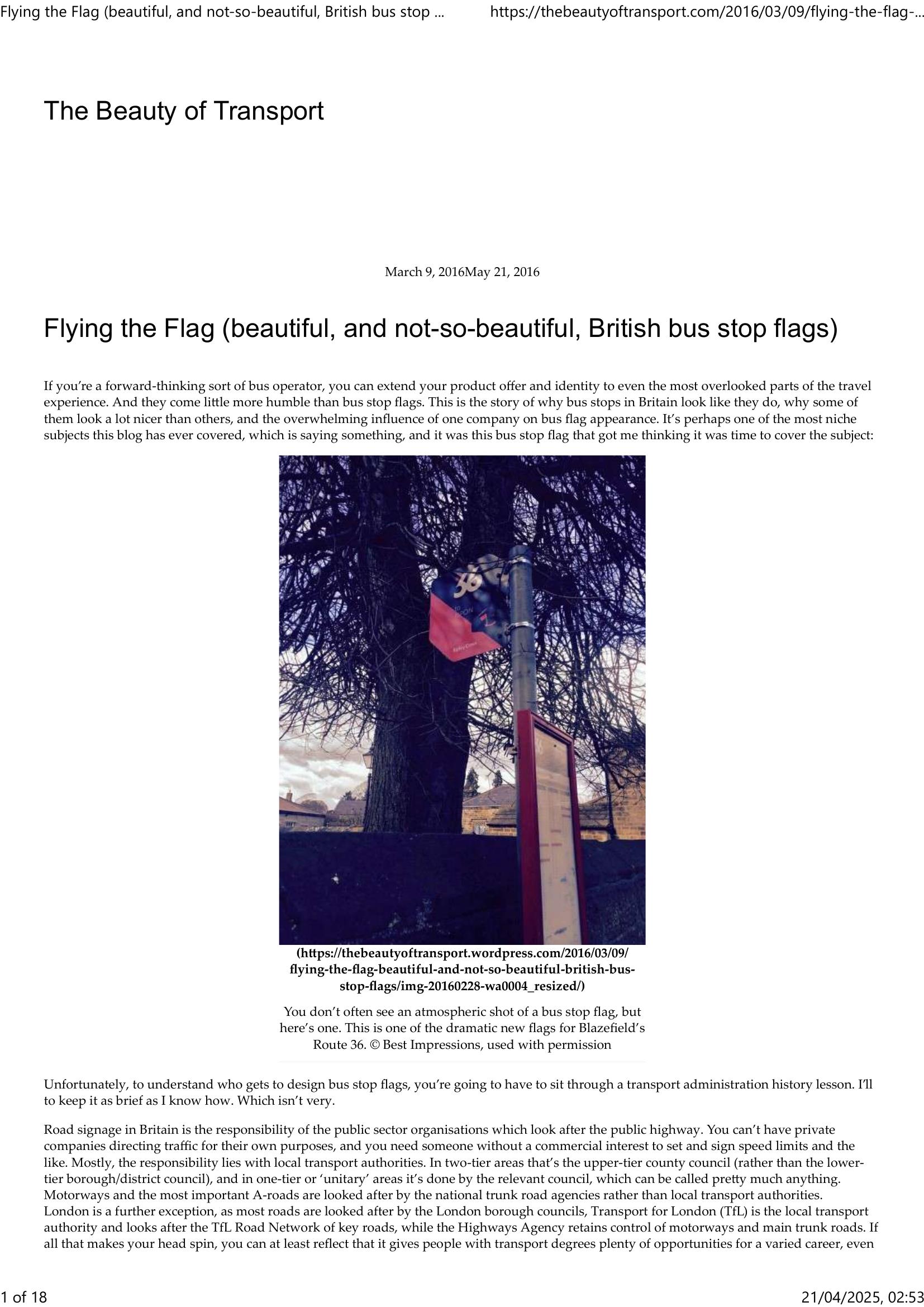
Wright – THE BEAUTY OF TRANSPORT – FLYING THE FLAG 2016
£0.00
A downloadable PDF file for your personal use.
Description
The article explores the overlooked but influential world of British bus stop flags, tracing their history from early company-installed signs through national standardization after the Worboys Committee and the TSRGD, to post-1986 deregulation when private operators multiplied and often cluttered stops with branded flags. While local transport authorities are formally responsible for road signage, many areas continued to let operators install and style flags, provoking inconsistency, legal worries and visual confusion. The TSRGD’s diagram 970 prescribes a standard but allows significant flexibility (typefaces, colours, panels, curved faces), which designers and transport firms—most notably Best Impressions and Stagecoach—have exploited to create distinctive, place-sensitive branding (e.g., Southern Vectis, Wilts & Dorset, Blazefield). Some public bodies remain conservative or inscrutable (TfGM, Merseytravel), though there are public-sector successes like Hampshire’s Eclipse and Surrey’s Guildford Park & Ride; the National Trust used private-land exemptions for bespoke wooden flags. The piece argues that well-designed flags can brighten streets and promote bus travel, while poor or overbranded signs harm legibility and confidence.
Additional information
| Pages | 18 |
|---|---|
| Filesize | 1.1Mb |
Related products
-
Anon – PICTURE THE TRANSIT SYSTEM EFFECTIVELY WITH A ROUTE MAP 1970
£0.00 Add to basket -

Association of Train Operating Companies – PASSENGER INFORMATION DURING DISRUPTION 2014
£0.00 Add to basket -
Attoma – MAPPING MOBILITY 2024
£0.00 Add to basket -

Anceresi, Gatti, Vecchi, Marelli and Rinaldi – A MAP OF WORDS 2023
£0.00 Add to basket