
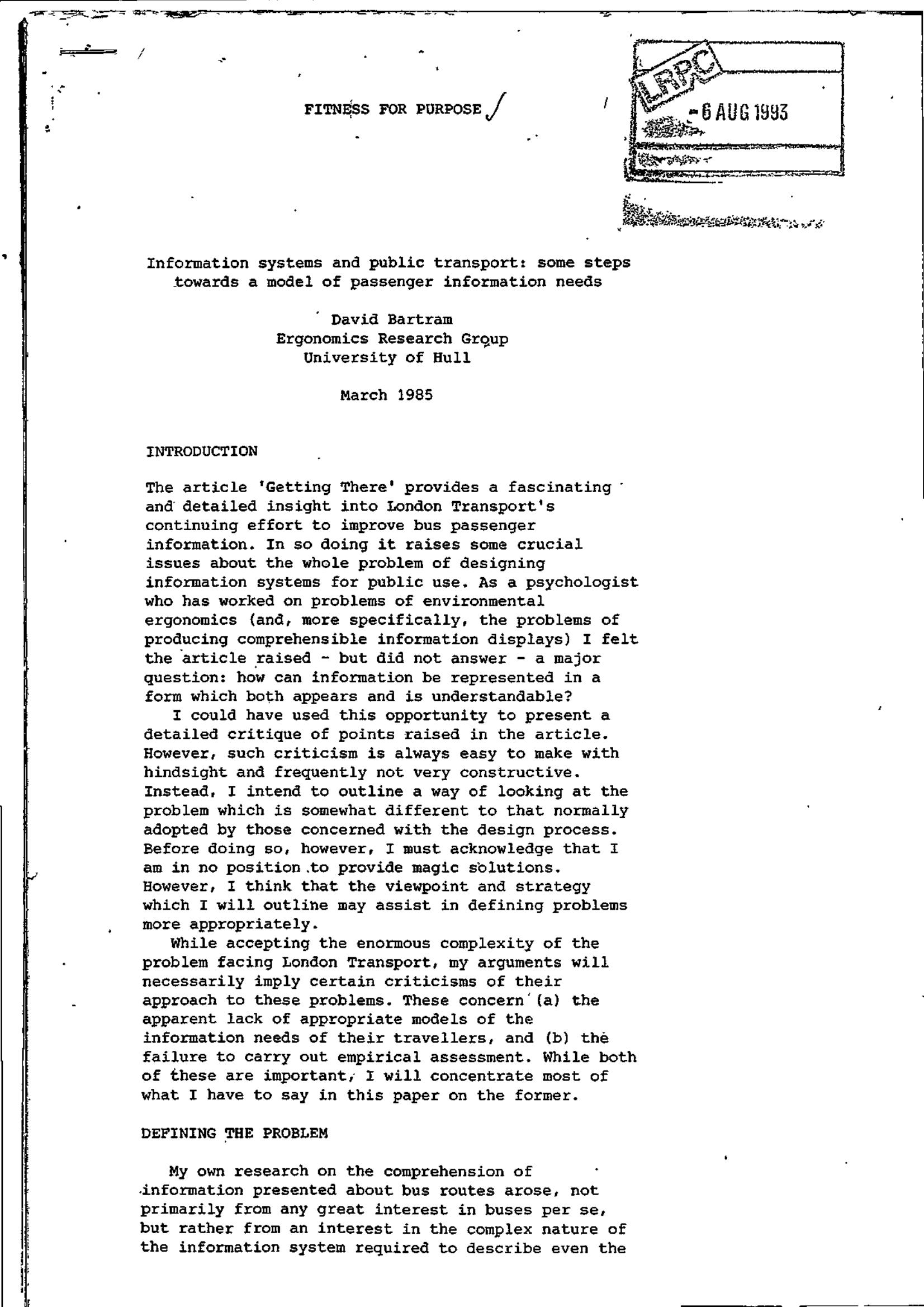
Bartram – FITNESS FOR PURPOSE 1983
£0.00
A downloadable PDF file for your personal use.
Description
David Bartram argues that effective public-transport information must be designed from a user-centered, ergonomic perspective rather than by intuition or by cramming data onto a single map. He frames information as a user-interface that gives travellers control, reduces uncertainty and anxiety, and supports decision-making at different journey stages. Bartram distinguishes three information types (knowledge, display, response) and three levels of user “system-competence” (low, moderate, high), each with distinct needs for planning, point-to-point guidance and in-transit confirmation. He advocates means-ends analysis to break journeys into sub-tasks and recommends separating street maps from highly schematized route planners while linking their elements. Empirical testing—lab and field studies—must guide design (legibility, reading age, colour vision, real-world lighting). Jonathan Roberts supplements this with a control–satisfaction feedback model and a “satisfaction per unit effort” yardstick to evaluate information utility. Both call for rigorous user models and systematic evaluation to improve passenger information effectively.
Additional information
| Pages | 26 |
|---|---|
| Filesize | 0.8Mb |
Related products
-

Anon – ONE-DIMENSIONAL TIMETABLES 1993
£0.00 Add to basket -
Association of Train Operating Companies – PRESENTATION OF TIMETABLE INFORMATION 1997
£0.00 Add to basket -

Association of Transport Co-ordinating Officers – PRINTED PUBLIC TRANSPORT INFORMATION 2003
£0.00 Add to basket -

Association of Train Operating Companies Information Development Group – GOOD PRACTICE GUIDES FOR CUSTOMER INFORMATION 2013
£0.00 Add to basket